
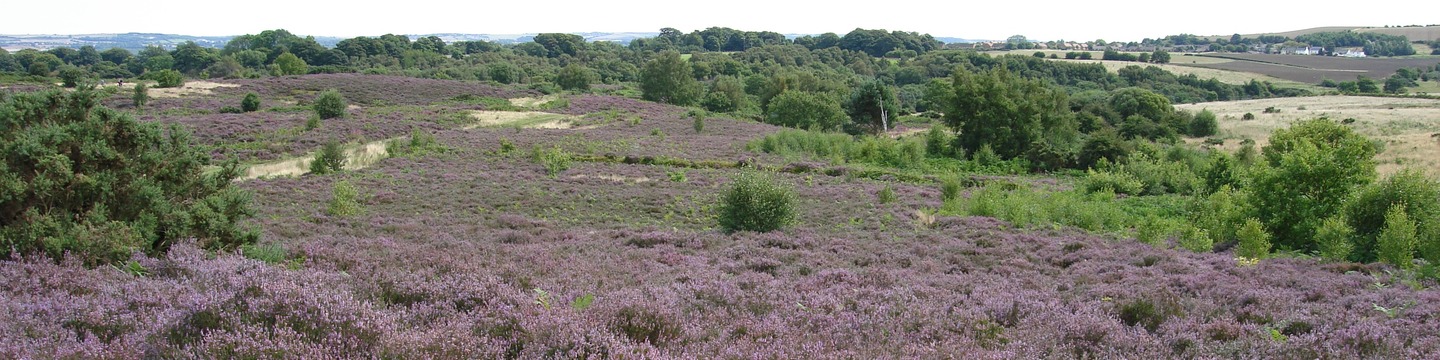
Waldridge Fell fencing proposals
Waldridge Fell is an incredibly rare lowland heath habitat in County Durham covering 113.5 hectares (0.44 square miles). It is one of only three lowland heath habitats in County Durham and is a Natural England Site of Special Scientific Interest (SSSI), a designation given to only the best wildlife habitats. This makes effective conservation management of the Fell a statutory obligation under the Wildlife and Countryside Act 1981. A variety of rare plant and animal species make their homes on the Fell and the heathland/peat is an effective carbon store.
What is happening?
We are considering installing two new sections of perimeter fencing in the south fell area of Waldridge Fell to support the future adoption of GPS-controlled conservation grazing. This is to help improve the heathland and biodiversity of the area and our conservation management of it.
We recognise that Waldridge Fell is an important place for local people to visit. So, although this proposal means some changes to the south fell area, we still intend to retain public access to it.
As Waldridge Fell is Common Land, we need to apply for permission from the Secretary of State to install the perimeter fencing and associated access gates.
Before submitting the application, we are giving you the opportunity to comment on the proposal and raise any questions or concerns you may have.
You will also be able to comment on the proposals as part of the application to the Secretary of State process.
Why the work is important
Several communities border the fell and it is a popular spot for locals to walk and do other outdoor activities. The fell is under pressure from this activity, with the heathland becoming increasingly damaged and disturbed. Work with our partner, Natural England, has led to recommendations to develop areas for seasonal grazing to help retain and enhance biodiversity and promote conservation.
Grazing for biodiversity is an extremely effective management practice and one that is carried out successfully on many other countryside sites across County Durham, including Wanister Bog and Daisy Hill.
Although conservation grazing would be a useful management tool for much of the lowland heath areas of Waldridge Fell, it would be most effectively introduced on the South Fell which exhibits increased amounts of habitat fragmentation, and a higher abundance of undesirable, competitive grasses and herbaceous species encroaching into dwarf shrub habitats and limiting the spread of heather and other heathland vegetation.
This work supports our commitment to conserve the county’s habitats and protect biodiversity. It is part of our statutory responsibility, our ecological emergency work, and the delivery of nature recovery strategies.
South fell proposal
The proposal is:
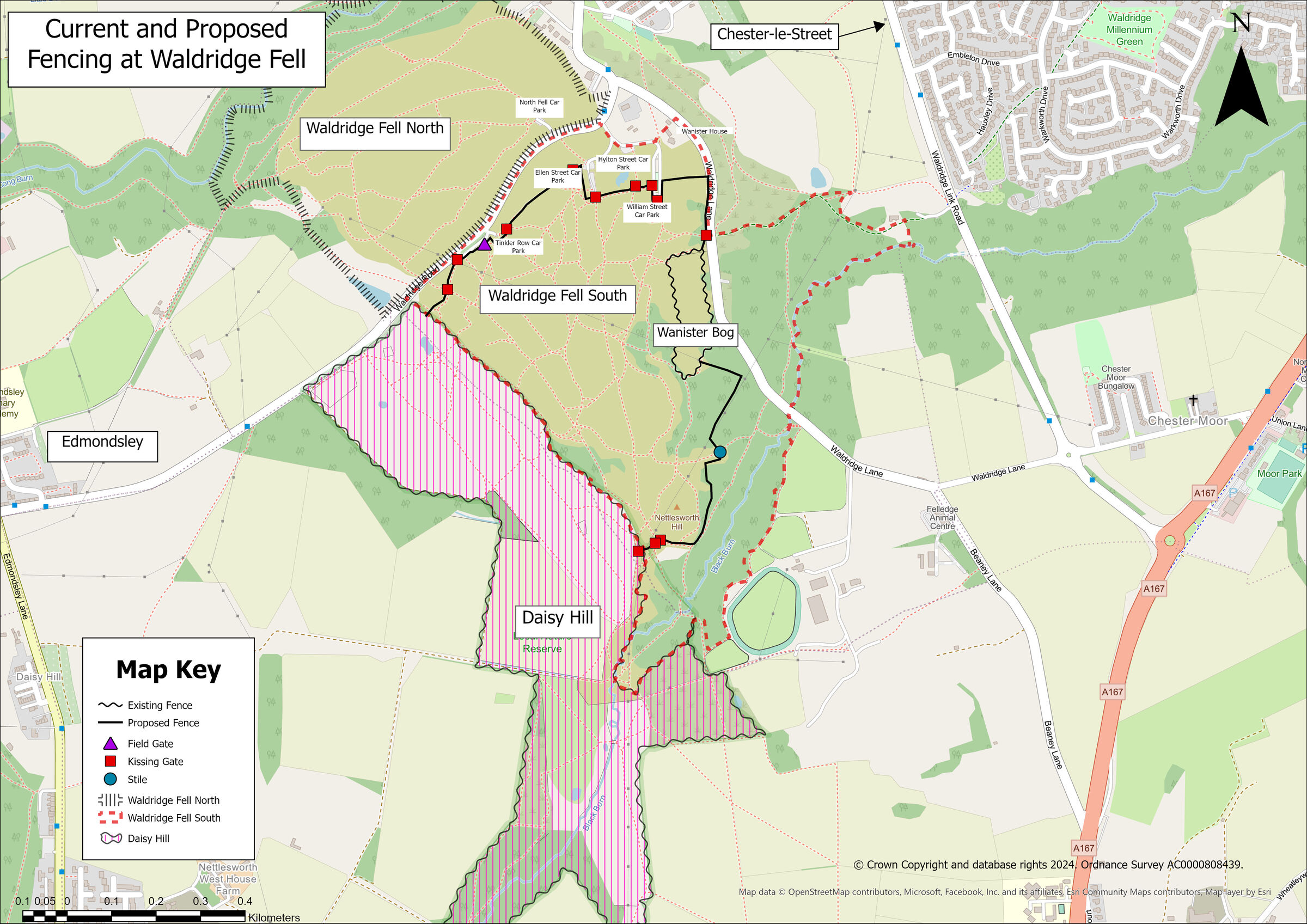
- to fence the perimeter of the south fell so we can use native cattle breeds to graze the area to help improve the condition of the heathland and enhance biodiversity
- to install new fencing in two separate sections that will join onto existing fencing around Wanister Bog and Daisy Hill
- to enclose other small compartments of land within the perimeter area using ‘Nofence’ GPS controlled grazing technology to keep grazing animals within a designated area using virtual fencing
- to install pedestrian gates, wherever possible, and stiles, where a gate is not possible, along existing paths in the south fell area so visitors can still access the area
- to display notices where people may come across livestock
The total area covered by the proposal is 33.5 hectares (0.13 square miles).
Map illustrating the fencing proposals
Virtual fencing
‘Nofence’ technology makes it possible to keep grazing animals within a designated area without physical fencing. The system will allow us to build smaller compartments within the physically fenced area using virtual fences (boundaries).
Concerns about grazing cattle
We understand people may be fearful of cattle.
Signs will be posted at access points on the main fence line to inform visitors that they are entering an area of grazing, and these will include a map of where the grazing sites are currently in operation and a recommendation of where people can walk to avoid the cattle. There will be no more than 10 cattle in a virtual boundary area and as its seasonal grazing, they will not be on the fell all year.
As with any area of countryside which has livestock, we will ask that dogs be kept on a lead and under close control, and that you close gates behind you.
North fell
The north fell area of Waldridge Fell will be unaffected. There will be no grazing cattle on the north fell (46 hectares (0.18 square miles), which has several walking routes including an easy access path.
Wanister Bog
As part of the application to the Secretary of State, we will also be asking to extend the existing successful management of the Wanister Bog area of the fell which was fenced and has been grazed since 2010.
Other conservation work
We are working to raise awareness of the importance of Waldridge Fell including scrub control, and tackling issues of anti-social behaviour such as poor dog control, dog fouling and wildfires.



The closing date for comments is Monday 2 November 2026.
Follow this consultation if you’d like to receive alerts about the progress of this proposal.
Equality Impact Assessment (EIA): As part of consultation an EIA was developed. For more information about EIAs visit our About Us page.
Phases
Comment on the proposals
- Fill in the online survey (above).
- Come to one of our drop in sessions (details to be published shortly).
- Paper copies of the information and survey will be available at the drop in sessions, or on request by emailing letstalkcountydurham@durham.gov.uk
- If you need the information in an alternative format, email letstalkcountydurham@durham.gov.uk
The closing date for comments is Monday 2 November 2026.
Events
Past events
Event date: October 24th, 2026 from 08:30 to 10:30.
Edmondsley parish hall
Event date: October 21st, 2026 from 13:00 to 15:00.
Edmondsley parish hall